Pedagogy is the art of teaching: that is the interaction between the teacher and the student and the resultant learning. Productive pedagogies are those that result in the best learning outcomes and should include:
deep knowledge through higher order thinking
collaborative learning where dialogue is imperative
enabling student to discover their learning styles
real life learning through problem-based, inquiry learning
relevant to students lives and cultures
students can be in control of their learning
engages students
supports individual students group identity and their development as an active citizen
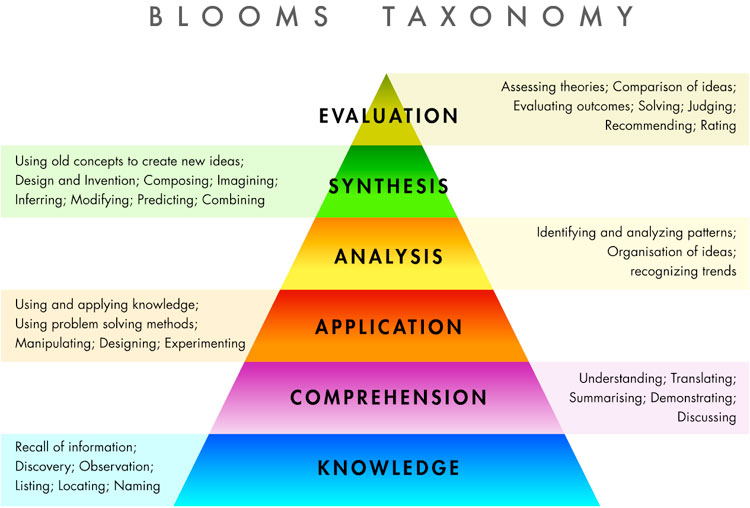
In education it is essential that a system or taxonomy is used to classify the evaluation processes and educational objectives (Veal & MaKinster, n.d.). Bloom's taxonomy is the most widely used in education as it was created to give educators and researchers a common language in which to discuss curriculum and evaluation.
This taxonomy refers primarily to Bloom's Cognitive Domain and it is important for educators to recognise the differences between simple knowledge such as observing, listing, naming and the higher order thinking skills required for assessing, analysing, comparing or judging. This will not necessarily be a linear process but one where the student will use and grow his own knowledge by using opportunities offered in his learning to hone his higher order thinking skills.
When looking at tertiary education, it does well to use Bloom’s
taxonomy to see the level of thinking that is required to complete assigned
tasks.If we look at the table above, noting
that the bottom level of the table, knowledge is one and the top is six, we
need to understand that university level assessment should require student to
perform at the third level and above (Chapman, 2008). Bibliography
Chapman, L.
(2008). Curriculum mapping: The aligned curriculum. Retrieved April 1,
2013, from University of New England:
http://www.une.edu.au/gamanual/staff/the_aligned_curriculum.pdf
Veal, W. R.,
& MaKinster, J. G. (n.d.). Pedagogical content knowledge taxonomies.
Retrieved March 12, 2013, from College of Education: University of Nevada:
http://wolfweb.unr.edu/homepage/crowther/ejse/vealmak.html
A SWOT anaylsis can be used to help define student knowledge on a topic. This can assist discovering what a student knows about a topic, misconceptions, obsticles to learning and what needs to be reinforced. Here is one that I created for the Wiki activity:
Strengths
·Allows all individuals to participate
including those who may be normally too shy to do so in class
·Collaborative
·Flexible
·Real world use of ICT
·Ongoing
·Allow for higher order thinking
·Reflective
·Analytical
·Easy to use
·Safe environment
·Information can be altered but previous
versions in history
·Trust
·Teacher can track individual student
participation through history
·Assessment can be built in
·Supports TPACK
Weaknesses
·Need ICT knowledge
·Need suitable hardware
·Students may not have internet access at home
·Computers may be ‘offline’ at times
·Can be fiddly, e.g. tables
·Teacher can’t be in control at all times
·Security needs to be firm
Opportunities
·Real world learning and teaching
·Students can use their creativity by embedding
multimodal tools
·Excellent opportunities for safe digital
citizenship experiences: cybersafety, copyright, netiquette
Who would have thought that there could be so many learning
styles? When I was at school (back when Adam was a boy), learning was strictly
based on the behaviourism(Learning-Theories.com,
2013)
where learning was simply a response to conditioning. This took the form of
repetition and involved lots of rote learning. Today multiple learning theories
abound.
Cognitivism(Mergel
B. , 1998)
later tried to explain learning in terms of mental processing. It was felt that
if we knew more about how the brain worked, we would understand how we learn.
They have explained the learning process in a three stage model:
the sensory register
working memory
long term memory
Constructivism
theory (Mergel
B. , 1998)
suggests that "learners construct their own reality or at least interpret
it based upon their perceptions of experiences," (Mergel, 1998). Also known
as social constructivism, it is founded on the notion that individual learning
comes from social interactions either within a learning or expert community.
Crucial to this learning theory is the support of the teacher who is
responsible for "scaffolding"
(Scaffolding,
2003)
the learning experiences. This scaffolding should involve demonstrations,
modelling, instruction, offering suitable tools and opportunities for
collaboration.
Siemens cited connectivism(Siemens,
2004)
as "the learning theory for the digital age,"as it bases itself on the networking nature
of learning that occurs using technology and the Internet. He notes that as it
is no longer possible to know all that we need to know, the new focus in
education should be on where and how to find knowledge. Using his analogy,
"the pipeline and its connections are more important than what is in the
pipeline" is the basis for this theory.
However, many educationalists believe that constructivism is
the most appropriate learning theory when we think about how ICTs can impact on
education as knowledge is constructed and built upon in collaboration with
other learners.
And what of learning styles? Indeed, many theories also exist
for this area. To me, the two most complete and applicable to the classroom are
those of Gardner’s
multiple intelligences(Paik,
1998)and
de Bono’s
Thinking Hats(De Bono Thinking
Systems, 2013).
Gardner’s research considered the biological factors that
can influence cognitive function ahead of psychological that previous
researchers had considered.His theory
suggests that there are seven different branches of intelligence:
Edward de
Bono(de
Bono, 2013) is
the man who gave us the term ‘lateral thinking.' His research looked at human
creativity.The Six Thinking Hats theory
that came out of this work is not so much about how we think, but how we should think to get the most out of our
creativity.
Scaffolding. (2003, July 21).
Retrieved March 30, 2013, from University of Tasmania:
http://www.educ.utas.edu.au/users/ilwebb/research/scaffolding.htm
De Bono Thinking
Systems. (2013). Six thinking hats. Retrieved April 2, 2013, from De
Bono's Thinking Systems: http://www.debonothinkingsystems.com/tools/6hats.htm
de Bono, E.
(2013). Biography of Edward de Bono. Retrieved April 4, 2013, from
Edward de Bono: Father of lateral thinking: http://www.edwdebono.com/biograph.htm
Learning-Theories.com.
(2013). Behaviourism. Retrieved April 2, 2013, from
Learning-Theories.com: http://www.learning-theories.com/behaviorism.html
Mergel, B. (1998,
May). Cognitivism. Retrieved April 2, 2013, from University of
Saskatchewan:
http://www.usask.ca/education/coursework/802papers/mergel/brenda.htm#The
Basics of Cognitivism
Mergel, B. (1998,
May). Constructivism. Retrieved March 30, 2013, from University of
Saskatchewan: http://www.usask.ca/education/coursework/802papers/mergel/brenda.htm#The
Basics of Constructivism
Paik, H. S.
(1998). One intelligence or many? Alternative approaches to cognitive
abilities. Retrieved March 6, 2013, from Personality Research:
http://www.personalityresearch.org/papers/paik.html
Siemens, G. (2004,
December 12). Connectivism: A learning theory for the digital age.
Retrieved March 17, 2013, from elearnspace:
http://www.elearnspace.org/Articles/connectivism.htm
When I started looking at the Group Three Tools I initially felt that I was covering old ground. I thought that PowerPoint had been done to death and its day had past (I once barely escaping an epileptic fit viewing some children's examples in the past!), but the learning activities in this section reminded me of the worthwhile learning objects that can be created with this tool. Prezi too, is another powerful tool. I prefer it over PowerPoint as it is online it is completely portable. I have seen too many PowerPoints fail because presenter failed to "pack" all the required fonts, pictures, videos, etc. required for the presentation to work effectively.
I selected Glogster, an online poster-making tool, as the one that I would explore further, as I felt that it had much to offer the lower to middle primary school students that I will be working with next term. The tool is multimodal as you can embed pictures, movies, audio files, text and hyperlinks, thus catering for different learning styles, literacy levels and ICT skills. Once created, you can share them with others either through Glogster accounts or embed your Glogs in your websites, blogs or wikis. When you have registered with the education section of the site, Glogster EDU, you can add class lists and monitor your students work. Privacy and student protection seem to be well catered for in this site.
There are a variety of lesson plans and resources available online for Glogster such as Read Write Think. With the adequate instruction on the use of this tool and sufficient activity scaffolding to keep children on task, Glogster can be a successful e-learning tool.
Bibliography
Stansbury, M.
(2008, March 26). Analysis: How multimedia can improve learning.
Retrieved March 24, 2013, from eSchool News:
http://www.eschoolnews.com/2008/03/26/analysis-how-multimedia-can-improve-learning/
I don't know about PowerPoint. I feel that I have experienced "Death by PowerPoint" so many times that surely, its day must be done. However, when looking at this tool as a means for the creation of learning objects I could see its usefulness. I created a small presentation using PowerPoint to use as a base for a unit on "Farm Animals".
I saved my PowerPoint as a movie file so that I could upload it to my blog. While it is no longer interactive, you can still get an idea as to how useful it may be as a tool in the classroom. It took quite some time to create as I am a little rusty with the animation and timing tools. I suppose that with regular use you would get faster. I'm still not convinced that there aren't better out there these days that would give you the same result for a lot less effort.
I love using Prezi! I find it relatively easy to use and the fact that it is online make it really portable. As you can just click on the page and add things, you can get up and running in no time at all. In the classroom, I would image that Prezi is a great way for students to explore topics using a mind mapping scenario. With its multimodality possibilities it would have many applications for students to explore and present information. Here is some great tips for uses for Prezi in the classroom: